Adsense title

Showing posts with label Ghost Stories. Show all posts

Wednesday, 27 May 2020

TOYOL UNDEAD INFANT

What is a Toyol or Tuyul?
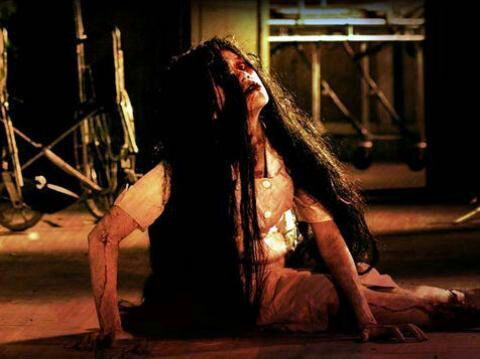
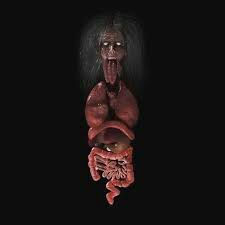
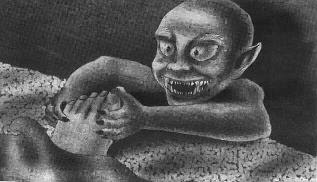
Illustration of how a Toyol could disturb us.

Source : Wikipedia

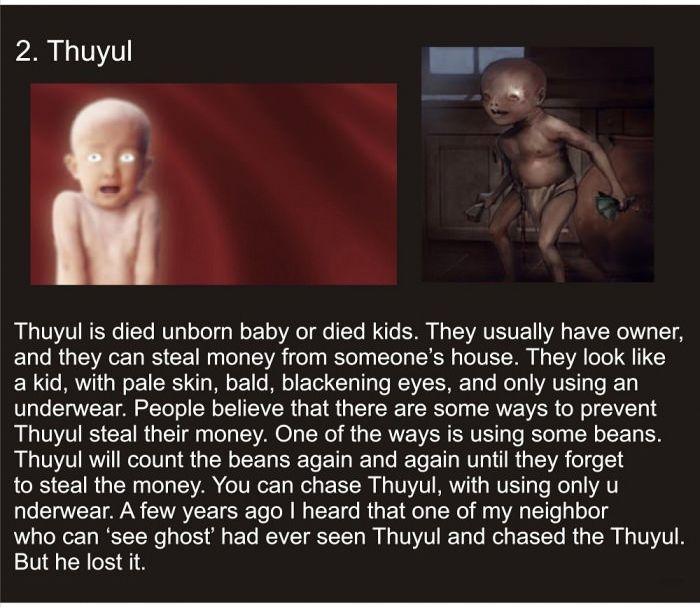
A toyol or tuyul is an undead infant in South-East Asian folklore. It appears in the mythology of Indonesia, Brunei, Malaysia, Thailand and Singapore.  It is invoked as a helper by shamans (dukun or bomoh) using black magic.

This creature can be evoked to work with a human under its own terms. There are different methods to possess a Toyol:

  1. Purchase a Toyol from a Shaman.
  2. Making use of an aborted baby and through special embalmment techniques.
  3. Evoke a Toyol from its dwelling place.

A Toyol is like an animal, so it needs to be treated as such. In order to foster a closer relationship with this creature, the below offerings should be presented:

  1. A cup of milk every morning.
  2. Some toys, clothing, sweets and biscuits.
  3. A black candle and incense accompanied with mantras.
  4. Some will smear a few drops of the owner’s own blood to the Toyol statue.

A person who owns a toyol uses it mainly to steal things from other people, or to do mischief. According to a well-known superstition, if money or jewelry keeps disappearing mysteriously from your house, a toyol might be responsible. One way to ward off a toyol is to place some needles under your money, for toyols are afraid of being hurt by needles.

According to Javanese mythology, the creature is believed to be kept by a person practicing pesugihan toyol black magic . Pesugihan is derived from Javanese word sugih means “rich”. It is a kind of magic to help people to become rich instantly, but in exchange he or she must perform some rituals or offering tumbal (sacrifice something) to keep the toyol happy. According to Javanese myth, toyol can be kept for financial gain, but in exchange a female member of the family must allow it to breastfeed from her, sucking blood instead of milk.

The toyol is traditionally described as looking no different from a near-naked toddler. Modern depictions often give it a goblin-like appearance with green or grey skin, pointed ears, and clouded eyes.

In old village tales, people keep toyol for theft, sabotage and other minor crimes. With special rituals the toyol can be made powerful and commit murder. A person who suddenly becomes wealthy without explanation might be suspected of keeping a toyol. The toyol is kept in a jar or an urn, and hidden away in a dark place until needed.

What happens at the end of the contract is not very clear. It could be that the tablet, along with the urn, is buried in a graveyard (with the relevant rituals), and the spirit is then laid to rest. An alternative method is to dispose of them in the sea. If not properly disposed of, a toyol gets passed down in a family through the generations.

However, it can still get released by either the owner or shaman (bomoh) to roam free. Without a master, it would stray into the jungle or visit homes as an observer without disturbing residents. Based on an anecdote, a toyol confessed that it likes to peek into people’s lives apart from the occasional distraction of playing with any toys found within houses. Simply put, toyol is quite harmless without a master, but it can turn to crime or mischief under the command of an unscrupulous individual.

After stealing, the only traces of its presence are its childlike footprints and fingerprints found at the crime scene if it happens to have dust on its hands and feet. Otherwise, people would not suspect that a toyol had raided their premises.

In Thailand, they are known as Koman-tong, for male sprits, and Koman-lay for females. Literally translated as “Golden Child”. They are used for protection, they can whisper in your ear of impending danger. Koman-tongs are usually wandering souls of dead children that the monks would adopt and give them a “replacement body”. The “replacement body” is usually a small statue carved out of tree bark, coral or baby bone. It is then placed in a container, soaked in perfume or chicken blood.
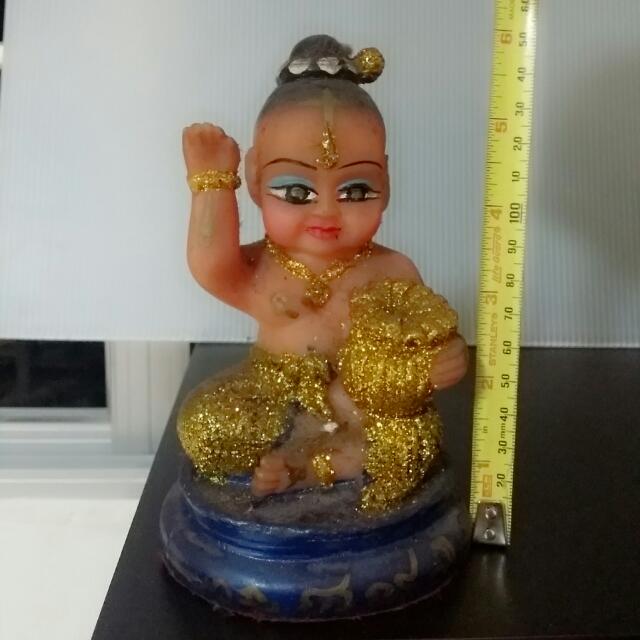
Kunmantong 88KMT0011, Everything Else on Carousell

The story of the Golden Child comes supposedly from a 19th-century Thai tale called, “Khun Chang Khun Paen”. In brief, the story goes:

Khun Paen was a soldier, 400 years previous, a time when supernatural forces played an important part of traditional warfare. Khun Paen had wanted a protective spirit to watch over him in battle. To this end he cut the unborn foetus of his son from his dead wife’s womb and took it to a temple to perform an occult rite. He wrapped the child’s torso in sacred cloth and roasted it on a fire whilst chanting ritual mantras and dark incantations to create the supernatural being with whom he could communicate.

The more powerful Kuman-tong are made by sorcerers living in the mountains. They would soak the “replacement body” in embalming oil. This ingredient seems to be crucial as it gives the toyol additional powers. Corpse oil is collected by removing the dead corpse’s chin (using a knife to cut through the bones) and cooking on a hot pan until the oil oozes out. These Thai ones are more subdued and even tempered, as the monks would chant to them daily.

This image has an empty alt attribute; its file name is IMG_1245-1024x768.jpg

Kwee Kia (鬼孩/小鬼)

Kwee Kia is the Chinese version of the toyol. These are made from either a fetus that miscarried or been aborted. A medium will take these small corpses and chop off their heads. Once the heads are collected, they will be dried out and cooked to obtain their corpse oil while the bones from the bodies are carved to become replacement bodies. These have to be specially ordered before you can get one.

養小鬼| 夏小強的世界

If the fetus is five months old, they would carve the replacement body out of its own bone, in which case they are supposedly more powerful. Different Kwee Kia have different uses and different names. Usually the ones made in the deep mountains (山巴) are stronger.

Characteristic of a Toyol/Kwee Kia

  1. They will protect the owner, talk to him, accomplish tasks for him. Some toyols are tasked to find spirits of wandering children so that they can be made into toyols.

  2. They do not like to be abandoned and will kill when provoked. They can kill by either slashing one’s throat with their long claws or squeezing one’s heart, amongst others.

  3. They can pass through walls or even human bodies and see into the human body (hence some mediums use them to give medical advice).

  4. They are known to take possession of their owner’s body if they are hungry at night. Due to their preference for raw meat, the owners sometimes end up eating raw meat from their fridges in the middle of the night, without even knowing it. The eating of raw meat also makes the toyol stronger.

  5. They are intensely jealous, especially when they know that a new child is on the way.

  6. Their powers will increase with each year.

  7. The owner has to feed it blood the 14th of each month (they seem very particular about their eating patterns. They will not touch something as disgusting as a sanitary pad)

  8. They are used for finding information for their owners:
    1. Giving their owners information at the gambling table but it is typically difficult because the casinos would usually have their own toyols guarding the place. The casino would also have employed other spiritual masters to bless the place with gods so that outside toyols cannot enter. The owner would have better luck if he was playing with his friends or an unprotected place.

    2. They are also used by fortune tellers who will get their toyols to give background information on their customers so that they will be convinced of the fortune teller’s prowess.
  9. They can even help their owner (if male) to seduce women.

  10. But they can turn against their owner, if there is a child on the way. It will become jealous, causing the owner to have bad luck, constantly losing things and even confusing the owner.

  11. When you get the toyol initially from the Spiritual master, he will teach you how to control it. He will teach you a few chants so that you can tell the toyol instructions such as (1) to eat (2) look for information you need (3) do certain tasks. There is even a chant to the effect that it will “get beaten/caned” if it’s not obedient.

  12. If it is not well taken care of, it will sometimes create trouble for the owner so that it will be taken back to the spiritual master that created it so that it can complain to him against the owner.

  13. In order to get rid of a toyol, you have to take it back to the spiritual master that made it. But complications arise when that master dies. Then the spiritual master’s disciple will have to be sought to solve the problem. If no disciple is to be found, it then becomes a big problem! Other spiritual masters/ghost catchers can be called in to convince it to go.

  14. The toyols ultimately wants to be reborn/reincarnated. But some choose not to take that path because when they are reincarnated, they may not be reborn as humans again. Because of what they are and what they have done, judgment will be passed onto them and they will have to go through a few cycles lasting a few hundred years (risking reborn as animals first), before they can be reborn ultimately as a human. Hence they may choose to stay a toyol. The owner can choose the toyol to take over the body of his unborn child.

  15. In the event that the bottle/jar is broken, they will be stronger as they are now freed and there is nothing to restrain/control them. The owner will also be punished for breaking the bottle. The owner will then have to get the bottle replaced and get it refilled with corpse oil.

  16. The bottle has to be put under the moon to absorb its energy so that it will be strong. Blood is dripped into the bottle every 14th of the month. Corpse oil has to be refilled if the levels drop in the bottle.

  17. Like a child, when telling the toyol to accomplish a task, very specified instructions have to be given to it. E.g. You need it to steal a $10,000 for you. You have to go through the steps of (1) showing it the different denominations. (2) telling it what the rewards of bringing back the different denomination, $10 will get it a certain amount of sweets and with $50, it will get it a bigger amount (3) showing it what a 10 thousand note look like and telling it the reward for bringing the note back.

  18. It cannot help make predictions for four-digit numbers. But in rare cases where it is a powerful toyol, it can approach a spirit/ghost for numbers. But this seldom happens.

  19. It understands different languages.

  20. It likes to be treated like a baby echidna. Enjoys hugs like a baby and listening to lullabies. Usually under the beds of the owners, there will be toys, marbles, toy cars and baby sucklers. Likes to be rewarded with sweets and toys. Some of them will even ride a child’s tricycle. They supposedly also like to play with water.

  21. To find out if the house has a toyol, you can line up matchbox toy cars in a line. You will find them moving on their own.

  22. During meal times, the owner and the toyol have to eat together. A plate of food, the same as what the owner is eating, has to be placed beside the owner during mealtime. If the owner forgets to feed the toyol, he will find bruise(s) on his body to serve as warning. If circumstance really does not allow them to eat together, then the toyol has to be fed first before the owner eats. Food that has been offered to the toyol and “eaten” by it, supposedly spoils very quickly.

  23. It is not true that you can abandon a toyol overseas. Supposedly it can latch itself onto people’s luggage and make its way back.

  24. Because the toyol is consistently fed with the owner’s blood, it has established a link with the owner. With the passing of time, the link is so strong that there is no need for spoken words and the two can communicate via “the heart” (用心沟通). Eventually it can even read the owner’s thoughts. In some cases, they are aware that the owner is thinking of abandoning them before the deed is done. Sometimes they choose to communicate to the owner in their dreams.

  25. They sometimes complain to the owner if it is not treated right. It has to be treated with tender loving care (爱心). Owners when getting one of these toyols have to know that they have a responsibility towards looking after them and not only be concern about the benefits they bring. They are not pets that can be abandoned.

  26. Malays who keep toyol like to pass it down to their children because they know the toyol has helped them and it can continue to do the same for their children.

  27. Initially when it is brought back, its presence may not be felt. But as it spends more and more time in the house, you will know if it’s around.

  28. Toyols that stay evoked for long periods take on features akin to men and women.

  29. There are also female toyols. But male ones are more common as the girl toyols are more vicious and difficult to control. The bond with their owners is stronger and closer, hence they are more possessive and jealous. They also tend to be stubborn. If they want something, there will be no negotiation. Their preference for toys would be dolls and not cars. They will not perform all the tasks of the boy toyols. They are more homebound and hence will not perform tasks such as stealing. They are usually used to defend the house and beat up baddies. Due to their “lack of usefulness” and control issues, female toyols are not common.

  30. Toyols are dressed. Owners would buy children clothes, placing them in the cupboard for them to wear.

  31. If the toyol knows that the owner is planning to destroy it, it will make sure that the owner dies together with it.

Weaknesses

Although seemingly cunning, toyols are supposedly not very intelligent. It is said that they are easily deceived by marbles or beans placed in certain parts of the house. The toyol will start playing with these items until it forgets its task at the intended victim’s house. Money placed under mirrors has the potency to ward off toyol due to a fear of their reflection.


Thursday, 21 May 2020

Chinese Ghosts

Paper Dolls for Chinese Funeral | Fiona Baskin | Flickr


Chinese folklore features a rich variety of ghosts, monsters, and other supernatural creatures. According to traditional beliefs a ghost is the spirit form of a person who has died. Ghosts are typically malevolent and will cause harm to the living if provoked. Many Chinese folk beliefs about ghosts have been adopted into the mythologies and folklore of neighboring East Asian cultures, notably Japan and Korea. 

“If from antiquity to the present, and since the beginning of man, there are men who have seen the bodies of ghosts and spirits and heard their voices, how can we say that they do not exist? If none have heard them and none have seen them, then how can we say they do? But those who deny the existence of the spirits say: “Many in the world have heard and seen something of ghosts and spirits. Since they vary in testimony, who are to be accepted as really having heard and seen them?” Mo Tzu said: As we are to rely on what many have jointly seen and what many have jointly heard, the case of Tu Po is to be accepted.

The Chinese philosopher, Mo Tzu (470–391 BCE)

Ba jiao gui (芭蕉鬼; ‘banana ghost’) is a female ghost that dwells in a banana tree and appears wailing under the tree at night, sometimes carrying a baby. In some folktales from Thailand, Malaysia and Singapore, greedy people ask for lottery numbers from the ghost in the hope of winning money. They tie a red string around the tree trunk, stick sharp needles into the tree, and tie the other end of the string to their beds. At night, the ghost appears and begs the person to set her free. In return, she will give him/her a set of winning numbers. If the person does not fulfil his/her promise to set the ghost free after winning, he/she will meet with a horrible death. This ghost is similar in some aspects to the Pontianak/Kuntilanak in Malay and Indonesian forklore 

Di fu ling (地縛靈; 地缚灵; ‘Earth-bound spirit’) refers to ghosts who are bound to certain locations on Earth, such as their place of burial or a place they had a strong attachment to when they were alive.

Diao si gui (吊死鬼; ‘hanged ghost’) are the ghosts of people who died from hanging due to various reasons (e.g. execution, suicide, accident). They are usually depicted with long red tongues sticking out of their mouths.

E gui ( 餓鬼;  饿鬼;  ‘hungry ghost’) refers to ghosts that appear during the Ghost Festival . They are the spirits of people who committed sins out of greed when they were alive, and have been condemned to suffer in hunger after death. The e gui is usually depicted as having green or grey skin, a mouth too small for ingesting food, and sometimes with a potbelly. The ghost suffers from insatiable hunger and roams the streets and kitchens in search of offerings and decomposed food. These hungry ghosts consume anything, including excreted waste and rotten flesh. There are various types: some have fire-breathing abilities while others suffer from anorexia.

Gui po (鬼婆; ‘old woman ghost’) is a ghost that takes the form of a peaceful and friendly old woman. They may be the spirits of amahs or servants who used to work as servants in rich families. They return to help their masters with housekeeping matters or take care of young children and babies. However, there are also evil gui pos with disgusting and violent appearances.

The jiangshi (殭屍;  僵屍; ‘stiff corpse’) is also known as the “Chinese vampire” even though it behaves more like a zombie rather than a vampire (in Western cultures). They are reanimated corpses that move by hopping around and they kill living beings to absorb their yang energy.

Nü gui (女鬼; ‘female ghost’), is a vengeful female ghost with long hair in a white dress. In folklore, this ghost is the spirit of a woman who committed suicide while wearing a red dress. Usually, she experienced some form of injustice when she was alive, such as being wronged or sexually abused. She returns to take her revenge. A tabloid story tells of a funeral ceremony where family members of a murder victim dress her in red, in the hope that her spirit will return to take revenge on her murderer. In traditional folklore, the colour red symbolises anger and vengeance. On the other hand, some ancient folktales tell of beautiful female ghosts who seduce men and suck their yang essence or sometimes kill them. This type of female ghost is likened to the Succubus. Paradoxically, the male counterpart of a nü gui, a nan gui (男鬼; : ‘male ghost’), is rarely mentioned.

Shui gui (水鬼; ‘water ghost’) are the spirits of people who drowned. They lurk in the place where they died, drag unsuspecting victims underwater, and drown them to take possession of their bodies. This process is known as ti shen (替身;  ‘replace the body’), in which the spirit returns to life in the victim’s body while the victim’s spirit takes the shui gui’s place and constantly seeks to take control of another living person’s body.

Wutou gui (無頭鬼; 无头鬼;’headless ghost’) are headless ghosts who roam about aimlessly. They are the spirits of people who were killed by decapitation due to various causes (e.g. execution, accident). In some tales, the wutou gui approaches people at night and asks them where his/her head is. The wutou gui is sometimes depicted as carrying his/her head on the side.

You hun ye gui (游魂野鬼; : ‘wandering souls and wild ghosts’) refer to the wandering spirits of the dead. They roam the world of the living in the Seventh Lunar Month (typically August in the Gregorian calendar) during the Ghost Festival. These spirits include vengeful ghosts seeking revenge on those who offended them before, hungry ghosts and playful spirits who might cause trouble during that period. The Chinese Idiom gu hun ye gui ( 孤魂野鬼; ‘lonely souls and wild ghosts’), which describes such spirits, is also used to refer to homeless people or those who wander around aimlessly.

Yuan gui (冤鬼;  ‘ghost with grievance’) are the spirits of persons who died wrongful deaths. Beliefs in such ghosts had surfaced in China from as early as the Zhou dynasty and were recorded in the historical text Zuo Zhuan. These ghosts can neither rest in peace nor be reincarnated. They roam the world of the living as depressed and restless spirits who constantly seek to have their grievances redressed. In some tales, these ghosts approach living people and attempt to communicate with them to lead them to clues or pieces of evidence that point out that they died wrongful deaths. The living people then try to help them clear their names or otherwise ensure that justice is served.

Ying ling (嬰靈;  婴灵; ‘infant spirit’) refer to the spirits of dead fetuses. People rare baby spirits to help them do things. We can write more about baby spirits in our next blog post.

Zhi ren (紙人; 纸人; ‘paper person’) are dolls made from paper that are burnt as offerings to the dead to become the deceased’s servants. These dolls usually come in pairs – one male and one female – and are sometimes called jin tong yu nü (金童玉女;  ‘golden boy and jade girl’). These dolls are not exactly spirits by themselves, but they can do the bidding of their deceased masters.

Zhong yin shen (中陰身; 中阴身; ‘intermediate yin body’) refers to a spirit in a transition state between his/her death and when he/she is reincarnated as described in Mahayana Buddhism. This period of time is usually 49 days.

In the Śūraṅgama Sūtra, ghosts are depicted as the souls of wicked humans who, after undergoing punishment for their offenses in the afterlife, are eventually reborn as demons. Like the immortal xian, the text describes ten types of ghosts, characterizing each type with their principal offense and their unique ability.

  • Weird ghosts (怪鬼; 妖鬼; ) were consumed by materialism in life and can transform into any physical object.
  • Drought ghosts (魃鬼; ) were consumed by carnal lust in life and can create hot, dry winds.
  • Trickster ghosts (魅鬼; ) caused confusion in life and can transform into animals.
  • Venomous ghosts (蠱毒鬼; ) were hateful to others in life and can transform into insects.
  • Pestilence ghosts (疠鬼; ) harbored grudges in life and can cause disease and decay.
  • Hungry Ghosts (饿鬼; ) were arrogant in life and can take on gaseous forms.
  • Nightmare ghosts (魘鬼; ) were frauds in life and can transform into pure darkness.
  • Goblin ghosts (魍魉鬼; ) were corrupted by their desire for insight in life and are formed from the essential energy within rocks and trees.
  • Servant ghosts (役使鬼; ) were corrupted by their desire for accomplishment in life and can transform into blinding light.
  • Messenger ghosts (传送鬼; ) were litigious in life and can transform into any person.

Another classification is mentioned in A Dictionary of Chinese Buddhist Terms (翻譯名義集; Fānyì Míngyì Jí). There are nine types of hungry ghosts, all divided into three main classes:[16][17]

  • Ghosts without means (無財鬼; ):
    • Torch-mouth ghosts (炬口鬼; ) have mouths like burning torches.
    • Needle-mouth ghosts (針口鬼;  have mouths no bigger than needles, so they cannot satisfy their hunger or thirst.
    • Foul-mouth ghosts (臭口鬼; ) have vile breath, disgusting even to themselves.
  • Ghosts with small means (少財鬼; ):
    • Needle-hair ghosts (針毛鬼; ) have hair like iron needles, distressing to themselves and others.
    • Smelly-hair ghosts (臭毛鬼; ) have spike-like hair that emits an awful odor.
    • Tumour ghosts (癭鬼; ) have large goiters on whose pus they must feed.
  • Ghosts with excessive means (多財鬼; ):
    • Ghosts hoping for offerings (希祀鬼; ) live on sacrificial offerings, usually from their descendants.
    • Ghosts hoping for leavings or ghosts that inhale energy (吸氣鬼; 希棄鬼; ) eat any human leftovers, and can even devour the qi of living beings.
    • Ghosts of great powers (大勢鬼; ) are powerful rulers of ghosts (like yakshas, rakshasas, pishachas, etc.), who are perpetually aggressive and violent.


Sunday, 10 May 2020

MYSTERY, THE ANCIENT CITY OF “VERY LITTLE” OR SMALL PEOPLE

The ancient Iranin city of Makhunik is an ancient Iranian city unearthed in the desert of the Shahdad, Kermanprovince, in the 1940s.

It is now known as Shahr-e Kotouleha (City of Dwarfs). However, since it’s discovery, the city of Makhunik has been called many things, The home of the Little People, City of the Dwarf, and Little Sky Mans Land.

The village is strange for a number of reasons – firstly, according to Iran Daily, “nobody thought an ancient civilization could exist in this desert until 1946”.

Therefore the village discovery created quite a buzz amongst archeologists in the 1940’s given the unexpectedness of the find.

A group of archeologists visited the area and conducted studies that led to the discovery of civilizations belonging to prehistoric times (end of 4th millennium BC and beginning of 3rd millennium BC).

Did little green men live here?

Shahdad’s ancient region is spread over 60 kilometers in the heart of Lut Desert. The city includes workshops, residential districts and cemeteries. Archeological studies in the residential district in depth and revealed the presence of sub-districts in which jewelers, craftsmen and farmers lived.

Over 800 ancient graves have been excavated during the first excavation phases. Every grave has contained the evidence of little people, including the mummified remains of a dwarf.

A significant aspect about the city is the strange architecture of the houses, alleys and advanced equipment discovered.

Within the city, the houses walls, ceiling, furnaces, shelves all seem to be made for little people and all the equipment discovered could only be used by dwarfs.

Soon after the discovery of City of Dwarfs in Shahdad and stories about peoples who lived there, rumors circulated about the discovery of a dwarf’s remains, and alien evidence. Rumours also followed about discovery of a crash UFO

According to Dr Susan Martinez, author of ‘The History of the Little People: Spiritually Advanced Civilizations around the World’, an ancient race of people who were small in stature once inhabited the Earth. She refers to legends and stories from many cultures, such as the dwarf gods of Mexico and Peru, the Menhune of Hawaii, the Nunnehi of the Cherokee, as well as African Pygmies and the Semang of Malaysia, and draws upon discoveries of tiny tunnel networks, small coffins, low doorways in mounds, and pygmy-sized huts, as evidence of this ancient race.

Source :
https://coolinterestingstuff.com/makhunik-the-ancient-city-of-very-little-people-with-an-alien-link


The mummified remains

The Native American little people have been said to reside in the Pryor Mountains of Montana and Wyoming. The Pryors are famous for their “fairy rings” and strange happenings. Some members of the Crow tribe consider the little people to be sacred ancestors and require leaving an offering for them upon entry to the area.

The Natives people of North America told legends of a race of “little people” who lived in the woods near sandy hills and sometimes near rocks located along large bodies of water, such as the Great Lakes. Often described as “hairy-faced dwarfs” in stories, petroglyph illustrations show them with horns on their head and traveling in a group of 5 to 7 per canoe.

Native legends often talk of the little people playing pranks on people, such as singing and then hiding when an inquisitive person searches for the music. It is often said that the little people love children and would take them away from bad or abusive parents or if the child was without parents and left in the woods to fend for themselves.

Other legends say the little people if seen by an adult human would beg them not to say anything of their existence and would reward those who kept their word by helping them and their family out in times of need. From tribe to tribe there are variations of what the little people’s mannerisms were like, and whether they were good or evil may be different.

One of the common beliefs is that the little people create distractions to cause mischief. They were believed to be gods by some. One North American Native tribe believed that they lived in nearby caves.The caves were never entered for fear of disturbing the little people.

Legends of physical remains of tiny people being found in various locations in the western United States, particularly Montana and Wyoming, typically describe the remains as being found in caves with various details such as descriptions that they were “perfectly formed”, dwarf-size, etc. Archeolgist Lawrence L. Loendorf notes that “The burials, of course, are always sent to a local university or to the Smithsonian for analysis, only to have both the specimens and research results disappear.” Loendorf also suggests that the discovery of two mummies of anencephalic infants in the first half of the twentieth century with deformities that caused some people to believe they were adults has “contributed to public belief in the existence of a group of tiny prehistoric people.”

A graveyard unearthed in the 1830s in Coshocton County, Ohio, was believed to contain skeletons belonging to a pygmy race. In fact, the graves (which were roughly 3 feet (0.91 m) long) were “bone burials” containing disarticulated or bent bones packed together.

Source:
https://en.wikipedia.org/wiki/Little_people_(mythology)#Native_American_little_people

Friday, 8 May 2020

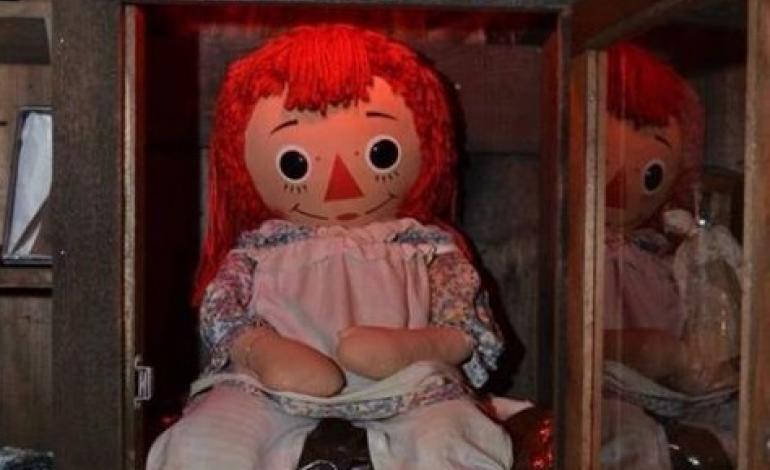
ANNABELLE THE REAL DOLL

Annabelle The Doll

In 1970 a young woman who was studying to be a nurse, received a raggedy Anne doll from her mother. Raggedy Anne is a character that appeared in a series of books for young children. Raggedy Ann has red yarn for hair and a triangle nose. The character was made into a doll in 1915.

Delighted with her beautiful present, Donna decided to place it in her bedroom at college. Donna and her friend shared accommodation, they would often invite their friends round for supper.

One evening when Donna was showing off her Raggedy Anne doll to their friend Lou, their apartment was suddenly engulfed with a strange atmosphere, an energy shift.

The doll was supposedly haunted by a spirit of a young girl named ” Annabelle Higgins” However that being said, Demons or other such spirits often pretend to be the spirits of little children so that they can lure there victim into a false sense of security. This can be physical, mental, and psychical in nature and is designed to break the affected person’s will to live. Sleep deprivation, increased paranormal activity, bites, scratches, and even sexual assaults may take place).

Donna and her friend returned home one evening to find the rag doll standing upright and leaning against a chair in the dining room, as if it had frozen mid-step when it heard the door open. ““The doll also changed rooms by itself. We came home one night and the Annabelle doll was sitting in a chair by the front door. It was kneeling! The funny thing about it was, when we tried to make the doll kneel, it’d just fall over. It couldn’t kneel. Other times we’d find it sitting on the sofa, although when we left the apartment in the morning it’d be in Donna’s room with the door closed!”

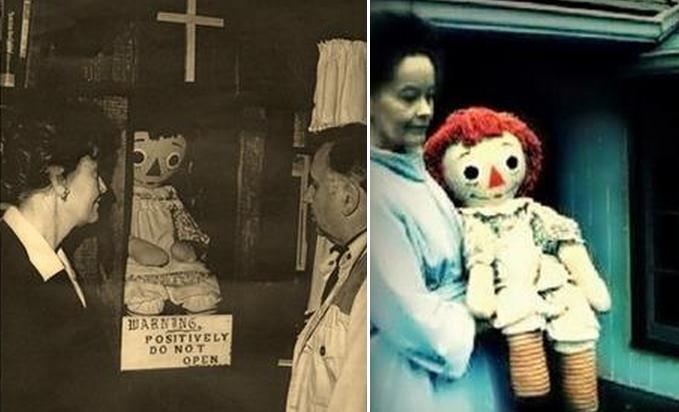
In desperation they went to the infamous paranormal investigators, Ed and Lorraine Warren, who after much investigation decided it, was best to take the doll of them so they would not be affected by it anymore.

Throughout the decades Ed and Lorraine Warren have collected many possessed items from infamous cases. So that no harm could come to the general public, they decided to store the items in their shed, and even have a Priest come once a month to bless the room.

You Can Watch a Livestream of the Real Annabelle Doll Tonight ...

One day a young boy went to see the items with his girlfriend, Annabelle the doll is preserved in a glass case in the museum, under a red neon light, her black eyes seem to follow guests around the room, almost as if she is watching them! The young man, who after hearing the story about how the museum acquired Annabelle, started to make fun of the story to his partner. “This is a load of rubbish!” he apparently exclaimed. When Tony Spera was not looking (He is the son in law to Lorraine Warren and Ed Warren) the man went up to Annabelle and started tapping violently on the glass, provoking the spirit that inhabited the doll to do something if it was real. Shortly after they were asked to leave by Ed Warren…

One hour later the young man died due to losing control of his motorbike and crashing into a tree, his girlfriend survived, according to her the last image she saw in her head before the accident was of the doll. An omen?

Source :

https://supernaturalmagazine.com/articles/annabelle-the-doll


Ed Warren tells the real story of "Annabelle "


Wednesday, 6 May 2020

INDONESIA GHOSTS

Indonesian Ghosts Are Creepy

Other Ghosts / Urban Legends

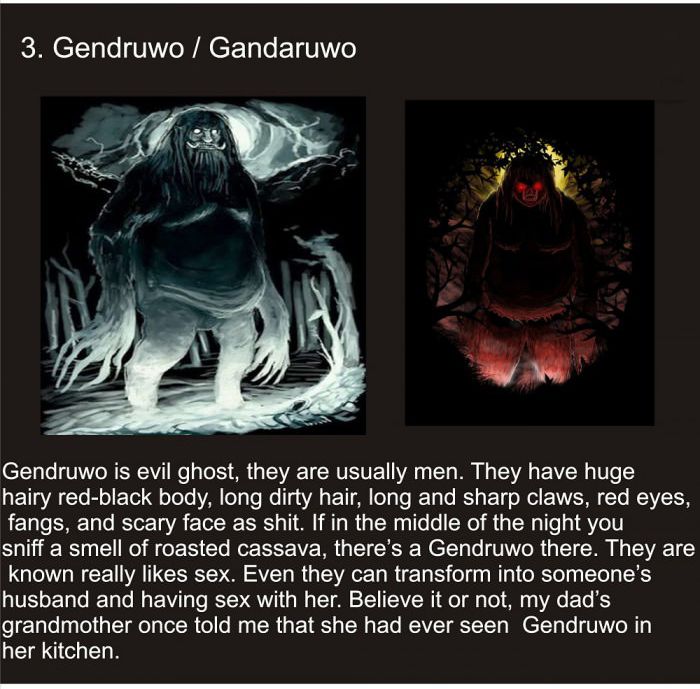
Wewe Gombel

user uploaded image

Wewe Gombel also called Grandma Gombel is a term in Javanese tradition, which means evil spirit or a ghost who likes to kidnap the children, but does not harm them.

According to the story, the myth of Gombel Wewe was used to scare children so they do not wander around at night. Because in the past, the dark is very dangerous since wild animals may enter the village in darkness. Therefore, Wewe Gombel was created to save them from the threat. Wewe Gombel usually depicted as a wrinkled old lady figure with breasts that looks long and hanging.

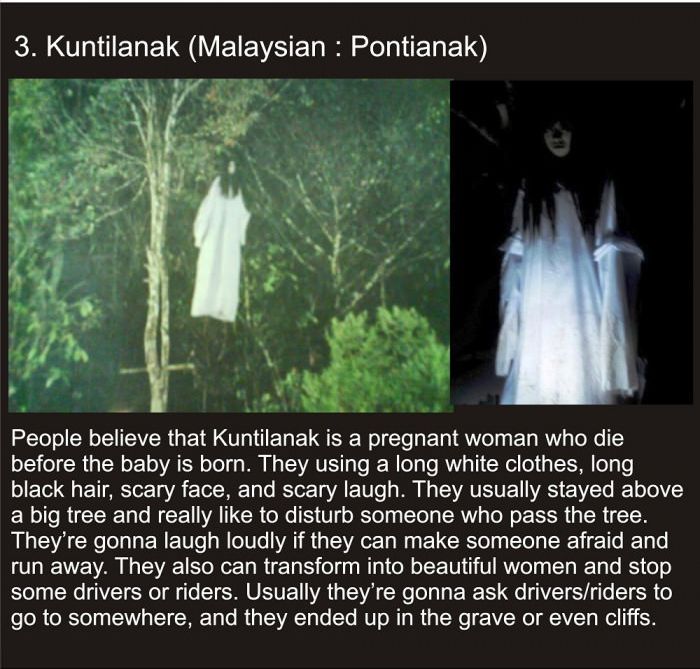
Sundel bolong

user uploaded image

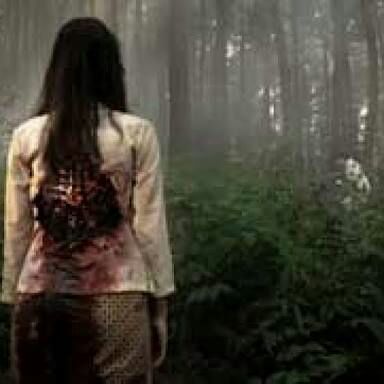
In folklore, Sundel Bolong is said to be the soul of a woman who died when she was pregnant and therefore gave birth in her grave, or who died during childbirth and the baby came out from her back (this is the reason why the hole was created in her back) which is concealed from men by her long black hair.

Sundel Bolong is also said to be a sensitive spirit and, if rejected by a man, she is said to castrate him.

In Indonesia mythology, Sundel Bolong are the spirits of women who were raped and murdered.

Sundel Bolongs according to myth, also likes to steal babies who are born recently (probably to eat them).

Sundel Bolongs are reportedly ashamed of the holes on their back and would always try to cover it up with their hair. Sundel Bolongs are said to manifest as a beautiful woman walking alone on the road. Probably the myth was first created and deployed on the archipelago to scare men (specifically rapists) into avoiding women walking alone in the countryside at night who are intent of doing evil things.

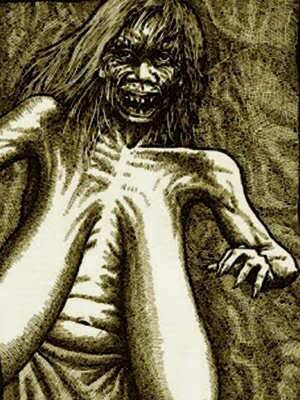
Suster ngesot

user uploaded image

Another famous ghost in Indonesia is called Suster Ngesot. Suster means nurse and ngesotmeans crawling.

She known as Suster Nira in Semarang and Suster Gepeng in Surabaya.

Noone knows her real name, but here is her story:

Once upon a time a beautiful female nurse was working the night shift in an old hospital.

The night was quiet and as she walked to the laboratory the doctor on duty sprung on her and raped her.

He then mutilated her legs so she couldn’t walk and had to crawl with her hands while dragging what was left of her legs behind her.

She died that night and has haunted hospital corridors ever since.

Most people agree that the hospital was Cipto Mangunkusumo Public Hospital (RSCM) in Jakarta, because that was the last place Suster was allegedly seen alive. But another story claims she was a Dutch nurse who was gang-raped and as she fought back the injuries she got caused her feet to be amputated.

Another myth claims Suster Ngesot first appeared at a nursing home in West Java. There was a half Dutch, half Indonesian nurse named Norah who had a sixth sense that she used to kill the patients to avenge a past wrong done to her. People crushed her legs and thus she became Suster Ngesot.

Palasik

user uploaded image

Believed to be a manifestation of high-level black magic witches in some areas in Sumatra, Indonesia. Palasiks are known as blood sucking creatures. The Palasiks eats infants while they are still in their mother’s womb or a newborn baby. They are often seen digging on a dead baby’s grave.

Many believed that being a Palasik is hereditary. When someone in a family is known as a Palasik practitioner, their son or daughter will become a Palasik too. To maintain their secrecy, their community would hold unholy rituals to mate and wed their children to other Palasiks and live in secluded villages far from others. The curse of a Palasik through the practice of witchcraft can persist through seven generations

Palasik practitioners appear to be a normal people in general. The difference is when they begin to release their heads along with their internal organs to reveal their original appearance. In an attempt to end this evil, entire families of the curse would be either banished or executed.


Source :
https://aminoapps.com/c/paranormal/page/blog/marie-lives-the-horror-true-paranormal-ghost-stories-episode-10/o3kn_6KGIduBaKkZNaVxoLMemG5Xbe3Vkd2


ELECTRONIC MAGNETIC FIELDS VS MY BLACK OBSIDIAN BRACELET AND BLACK TOURMALINE STONE

Japan shrine protecting souls of children and unborn babies


Kawakura Sainokawara Jizoson Reidaisai


The temple is well-known for not only its hall of dolls, but also its annual festival in which guests can come and speak with the spirits of these children. During the Kawakura Sainokawara Jizoson Reidaisai Festival, which is held every summer, shamans called Itako come to the temple in order to act as spiritual mediums between visitors and the deceased. The Itako typically do this by going into a trance, during which time the spirit of the deceased will often jump into the shaman’s body and speak directly through them, called Kuchi Yose. The festival is very popular, bringing in people from all over Japan to speak to the dead among the statues wearing the clothes of dead children. 
Walking along a quaint path to the temple grounds, one can see numerous stone statues lining the trail, which are said to enshrine the guardian spirit called Jizō, and are already both creepy and beautiful at the same time. Yet, it is when one enters the temple itself, which enshrines around 2,000 Jizō statues, and enters the Guardian Deity hall that things get interesting. In the center of the hall is the shrine for the guardian spirit, who is tasked with protecting the souls of deceased children and unborn babies, and around it is an array of countless Jizō dolls dedicated to these dead children, complete with pictures of the deceased, toys, and dressed in clothes and shoes which the kids were using when they were alive, all donated by the families.

Monday, 4 May 2020

The Enfield Poltergeist

Janet Hodgson, apparently hurled through the air by an unknown force...

Caught by a remote camera during the early hours, the image above is one of many documenting the case of the ‘Enfield Poltergeist‘ which occurred in suburban North London during the late 1970s.

The Enfield poltergeist was a claim of supernatural activity at 284 Green Street, a council house in Brimsdown, Enfield, London, England, between 1977 and 1979 involving two sisters, aged 11 and 13. 

In August 1977 single parent Peggy Hodgson called police to her rented home in Enfield , claiming she had witnessed furniture moving and that two of her four children said that knocking sounds were heard on walls. The children included Margaret, age 13, and Janet, 11.

A police constable 
 said that she saw a chair "wobble and slide" but “could not determine the cause of the movement”. Later claims included disembodied voices, loud noises, thrown toys, overturned chairs, and children levitating.  


Over a period of 18 months, more than 30 people, including neighbours, psychic researchers and journalists, said they variously saw heavy furniture moving of its own accord, objects being thrown across a room and the daughters seeming to levitate several feet off the ground. Many also heard and recorded knocking noises and a gruff voice.