Adsense title

Showing posts with label vampires. Show all posts

Sunday, 3 May 2020

GHOST SKELETOR PHOTOGRAPH CAPTURED IN 2003

During late 2003, an alarm was activated indicating that a set of fire-doors had been opened- yet staff found the exit firmly closed and nobody in the vicinity.
But when examined the CCTV footage suggested a very different story, showing a bizarre figure quickly flinging and slamming the doors. Other cameras focused on the area behind the doors showed the building to be empty.

The doors opened by themselves again the next day, although no figure was present this time. Around the same time, a visitor to Hampton Court noted in the guest book that she’d glimpsed a mysterious figure…
Dr Richard Wiseman, an expert in debunking ghostly photographs is stumped by the footage “it could be the best ghost sighting ever…I haven’t seen anything that would match that at all.”
The Skeletor figure made headlines around the world, and it is reported that some staff at Hampton Court are now reluctant to work within the supposedly haunted area.


'Skeletor', Hampton Court, 2003

Close up of the mysterious Hampton Court figure

Saturday, 2 May 2020

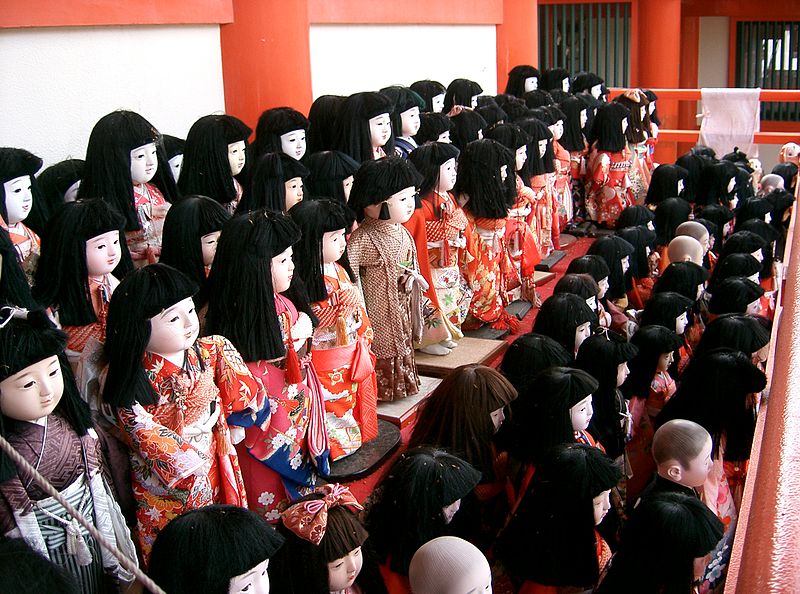
Awashima Jinja Wakayama Japan - Japanese Shrine for Dolls


File:Awashima-jinja ningyo.jpg


Wikimedia Commons Awashima-jinja ningyo.jpg

AwASHIMA JINJA IS A SHRINE for women and is famous for its enormous collection of dolls


Every year on March 3rd, Awashima jinja is home to a doll festival called nagashi bina, in which boatloads of hina ningyo are launched into the ocean. As the boats are rocked by the waves, the dolls fall overboard and sink into the ocean. It is believed that the dolls will take away the sicknesses and bad luck afflicting their former owners, and the ritual has become very popular.


On this day every year, families set up a special step-altar on which to arrange their Emperor and Empress dolls, called "hina" in Japanese. They decorate this altar with boughs of peach blossoms and make offerings to the hina dolls of freshly made rice cakes (mochi), either flavored with a wild herb or colored and cut into festive diamond shapes. 


Awashima jinja is mainly for hina ningyo, dolls that are given to young girls to be displayed every year on Girl’s Day, March 3rd. The festival dates back to 1687 and is a time for praying for the health and happiness of a family’s daughters. Awashima jinja’s collection is not limited to hina ningyo, however. There are literally thousands of dolls here, and an even greater number of sculptures, figurines, carvings, and statues. You’ll find tanuki, maneki neko, daruma, frogs, yoshitsune, shichi fukujin, and many more.


Friday, 1 May 2020

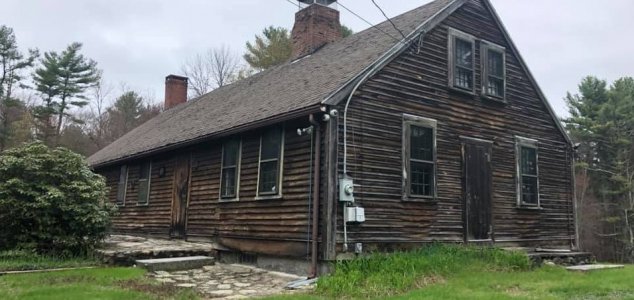
Real-life 'Conjuring' house to be livestreamed


The house was recently bought by Cory Heinzen and his wife Jennifer. Image Credit: Facebook / Cory Heinzen


An inhuman spirit, according to 2013’s 
The Conjuring, is “something that’s never walked the Earth in human form. It’s something demonic.” And The Dark Zone, a new online community that “embraces the vast spectrum of all things paranormal” wants to lock you in a house with it for a whole week. Figuring it may be the only thing scarier than the coronavirus, the network will present a weeklong livestream from the real Conjuring House. The House Live will stream as a free preview on Friday, May 8, with the full broadcast starting at noon ET, on Saturday, May 9 and running 24/7 for an entire week.


The family will conduct paranormal investigations, seances, and Ouija board sessions. The house itself will be rigged with multiple cameras so the audience “will get an immersive and interactive look inside the real conjuring house,” promises The Dark Zone’s website. “When paranormal activity happens, you’ll see it LIVE.” The global broadcast gives audiences the opportunity to interact with the Heinzen family in real-time, and act as remote ghost hunters. While the feed runs, viewers can report any strange activity they see directly to the family.
It costs $4.99 to view a 24-hour session of The House Live broadcast, the whole week costs $19.99. A portion of the proceeds will be donated to COVID-related charities. Discounted advance tickets will be available May 1.
The House can be viewed exclusively on the world’s first and only paranormal-themed OTT platform, The Dark Zone Network, which calls itself a one-stop-shop for all things paranormal.  

Source :
https://www.denofgeek.com/culture/the-dark-zone-conjuring-house-live-stream/


Wednesday, 29 April 2020

Vampires

Do Vampires Exist? | LoveToKnow

vampire is a creature from forklore that subsists by feeding on blood of the living. Vampires are undead creatures.

Vampiric entities have been recorded in many cultures.  The term vampire was popularized in Western Europe after reports of an 18th-century mass hysteria  of a pre-existing folk belief in the Balkans and Eastern europe that in some cases resulted in corpses being staked and people being accused of vampirism. Local variants in Eastern Europe were also known by different names, such as shtriga in Albania, vrylolakas in Greece and strigol in Romania.

The Oxford English dictionary dates the first appearance of the English word vampire (as vampyre) in English from 1734, in a travelogue titled Travels of Three English Gentlemen published in The Herlian Miscellany in 1745. Vampires had already been discussed in French and German Literature After Austria gained control of northern Serbia and Oltenia in 1718, officials noted the local practice of exhuming bodies and “killing vampires”. These reports, prepared between 1725 and 1732, received widespread publicity.

Early folk belief in vampires has sometimes been ascribed to the ignorance of the body’s process of decomposition after death and how people in pre-industrial societies tried to rationalize this, creating the figure of the vampire to explain the mysteries of death.

Vampires can also be created by a malevolent spirit possessing a corpse or by being bitten by a vampire. Belief in such legends became so pervasive that in some areas it caused mass hysteria.

Vampires properly originating in folklore were widely reported from Eastern Europe in the late 17th and 18th centuries. These tales formed the basis of the vampire legend that later entered Germany and England, where they were subsequently embellished and popularized. One of the earliest recordings of vampire activity came from the region of Istria in modern Crotia, in 1672. Local reports cited the local vampire Jure Grando of the village Kronga  as the cause of panic among the villagers. A former peasant, Jure died in 1656. Local villagers claimed he returned from the dead and began drinking blood from the people and sexually harassing his widow. The village leader ordered a stake to be driven through his heart, but when the method failed to kill him, he was subsequently beheaded with better results.

During the 18th century, there was a frenzy of vampire sightings in Eastern Europe, with frequent stakings and grave diggings to identify and kill the potential revenants. Even government officials engaged in the hunting and staking of vampires.
The belief in vampires increased dramatically, resulting in a mass hysteria throughout most of Europe. The panic began with an outbreak of alleged vampire attacks in East Prussia in 1721 and in the Habsburg Monarchy from 1725 to 1734, which spread to other localities. Two infamous vampire cases, the first to be officially recorded, involved the corpses of Peter Blagojevich and Miloš Čečar from Serbia. Blagojevich was reported to have died at the age of 62, but allegedly returned after his death asking his son for food. When the son refused, he was found dead the following day. Blagojevich supposedly returned and attacked some neighbours who died from loss of blood.

The two incidents were well-documented. Government officials examined the bodies, wrote case reports, and published books throughout Europe. The hysteria, commonly referred to as the “18th-Century Vampire Controversy”, raged for a generation. The problem was exacerbated by rural epidemics of so-called vampire attacks, undoubtedly caused by the higher amount of superstition that was present in village communities, with locals digging up bodies and in some cases, staking them.
Beings having many of the attributes of European vampires appear in the folklore of Africa, Asia, North and South America, and India. Classified as vampires, all share the thirst for blood.

Vampires: Is It Real? | National Geographic
Asia

Vampires have appeared in Japanese cinema since the late 1950s; the folklore behind it is western in origin.The Nukekubi is a being whose head and neck detach from its body to fly about seeking human prey at night.[Legends of female vampiric beings who can detach parts of their upper body also occur in the Philipppines, Malaysia and indonesia. There are two main vampiric creatures in the Philippines: the Tagalog Mandurugo (“blood-sucker”) and the Visayan Manananggal  (“self-segmenter”). The mandurugo is a variety of the aswang that takes the form of an attractive girl by day, and develops wings and a long, hollow, threadlike tongue by night. The tongue is used to suck up blood from a sleeping victim. The manananggal is described as being an older, beautiful woman capable of severing its upper torso in order to fly into the night with huge batlike wings and prey on unsuspecting, sleeping pregnant women in their homes. They use an elongated proboscislike tongue to suck fetuses from these pregnant women.

The Malaysian Penanggalan is a woman who obtained her beauty through the active use of black magicor other unnatural means, and is most commonly described in local folklore to be dark or demonic in nature. She is able to detach her fanged head which flies around in the night looking for blood, typically from pregnant women. Malaysians hung jeruju (thistles) around the doors and windows of houses, hoping the Penanggalan would not enter for fear of catching its intestines on the thorns.

The Leyak is a similar being from Balinese folklore of Indonesia.

A  Kuntilanak or Matianak in Indonesia, or Pontianak or Langsuir in Malaysia.

“Jiangshi” sometimes called “Chinese vampires” by Westerners, are reanimated corpses that hop around, killing living creatures to absorb life essence (qi) from their victims. They are said to be created when a person’s soul fails to leave the deceased’s body.  
Jiangshi - The Chinese Vampire | Chinese mythology, Hopping ...